

Every Dubai renovation passes two gates: the master developer's NOC and, for structural, MEP, layout or external work, a Dubai Municipality, Trakhees or DDA permit. This guide explains who approves what, the documents, the fees, the timelines and the mistakes that cost weeks.
Every renovation in Dubai passes through two gates before a single wall comes down: the master developer who owns the community rules, and the government authority that owns the building code. Miss either and the consequences range from a stop-work notice and a fine to a forced reinstatement at your own cost. This guide explains who approves what, which jobs need a permit and which do not, what it costs, how long it takes and the mistakes we see most often. It reflects how SITES Design & Build handles approvals as part of project management on every villa and apartment we touch.
Dubai's two-tier approval system
Think of it as community first, authority second. The two run in sequence because the authority expects to see the developer's approval in the permit pack.
Tier 1: the master developer NOC
Emaar, Nakheel, Meraas, DAMAC and Dubai Properties each publish community guidelines and issue a No Objection Certificate for work inside their communities. The NOC confirms your proposed changes respect the community's architectural controls, setbacks, external appearance and neighbour impact. Typical 2026 figures are AED 2,000-5,000 plus a refundable security deposit, with 5-15 working days to issue once the submission is complete. Even cosmetic work that needs no government permit usually still needs the community NOC, because the developer controls who comes through the gate.
Tier 2: the building permit authority
Which authority depends on where the property sits. Dubai Municipality (DM) covers most of the city. Trakhees, the regulatory arm of the Ports, Customs and Free Zone Corporation, covers Nakheel communities including Palm Jumeirah, plus JAFZA and Dubai South areas. The Dubai Development Authority (DDA) covers its own free zone communities. The permit is the authority's check that structural, fire and MEP changes meet code, and it comes with inspections and a completion certificate at the end.
| Body | What it approves | Typical cost (2026) | Typical timeline |
|---|---|---|---|
| Master developer (Emaar, Nakheel, Meraas, DAMAC, Dubai Properties) | Community NOC for any works, external changes, contractor access | AED 2,000-5,000 plus refundable deposit | 5-15 working days |
| Dubai Municipality | Building permit for structural, MEP, layout, external and extension works | Per DM fee schedule, scaled to scope | 10-15 working days |
| Trakhees | Same scope as DM in Nakheel, JAFZA and Dubai South areas | Per Trakhees fee schedule | 10-20 working days |
| DDA | Building permit in DDA free zone communities | Per DDA fee schedule | 7-14 working days |
| DEWA | Changes to electrical load, water supply or AC capacity | Load and connection fees as applicable | Runs alongside the permit |
| Dubai Civil Defence | Fire alarm, sprinkler, emergency lighting and escape routes | Fee per submission | Runs alongside the permit |
What needs a permit, and what does not
Usually no DM or Trakhees permit (but often a community NOC)
- Painting and decorating, inside and out where the colour is within community rules
- Replacing flooring like for like, with no change to levels or waterproofing
- Swapping sanitaryware, taps and light fittings in the same positions
- Fitted wardrobes and loose joinery that does not touch services
- Replacing kitchen cabinets in the same layout with no new electrical or drainage points
Permit required
- Removing, moving or adding walls, including non-structural partitions in many communities
- Any structural change: openings in load-bearing walls, slab cuts, new staircases, mezzanines
- Extensions, additional floors, roof structures and pergolas with fixed roofs
- Relocating kitchens or bathrooms, adding bathrooms or moving drainage
- Increasing electrical load, adding or moving AC units, new DEWA connections
- Swimming pools, water features and landscaping with retaining structures
- External changes: facade, windows, boundary walls, gates and external colour in controlled communities
Rule of thumb: if the work changes the structure, the services, the layout or the outside of the house, assume it needs a permit. If it only changes the finishes, assume it needs an NOC.
The documents you will be asked for
- Title deed, or Oqood for off-plan, proving ownership
- Owner's Emirates ID and passport copy, plus a signed authorisation letter if a consultant or contractor is applying on your behalf
- Ejari tenancy contract and landlord consent if the property is tenanted
- The contractor's valid trade licence and Dubai Municipality or Trakhees registration in the right category
- The contractor's public liability insurance certificate
- Drawings: existing and proposed plans, elevations where external changes apply, structural calculations for structural work, MEP drawings where services change
- The community NOC itself, since the authority expects the developer's approval in the pack
Fees and timelines at a glance
Typical Dubai market figures in 2026 are a community NOC of AED 2,000-5,000 plus a refundable deposit, with authority permit fees set by each body's schedule and scaled to the work. On timelines, allow 5-15 working days for the NOC, then 10-15 working days for DM, 7-14 for DDA or 10-20 for Trakhees. Run end to end with no resubmissions, that is 3-7 weeks before demolition can legally start. With one resubmission, which is common on a first attempt, add 2-3 weeks.
Common mistakes we are asked to fix
- Starting cosmetic work without the community NOC. Security stops the contractor at the gate and the deposit conversation becomes awkward.
- Applying to DM when the villa is under Trakhees. On Palm Jumeirah this wastes two to three weeks before anyone notices.
- Submitting drawings that do not match the villa. Developers keep the approved plans; if your existing-condition drawings show a previous owner's unapproved extension, the whole file is queried.
- Treating DEWA as an afterthought. New AC capacity for an extension can need a load upgrade with its own lead time, and discovering it at commissioning means a hot summer.
- Hiring a contractor whose licence category does not cover the work. The permit is refused and the quote was never real.
- Skipping Civil Defence on a villa with an existing fire alarm or sprinkler system because it is only a renovation.
- Forgetting the completion certificate. Without the final inspection and sign-off, a future buyer's bank valuation can flag the works and a resale slows down.
How a project manager handles approvals
At SITES, approvals are a workstream with its own programme, not a form someone fills in between site visits. The sequence looks like this:
- A jurisdiction check on day one: which developer, which authority, which community rules apply, and whether the villa's existing approved drawings match reality.
- A scope split into NOC-only items and permit items, so cosmetic work can start under the NOC while the permit pack is prepared.
- Drawings produced by our own architecture and design team in the authority's required format, with structural and MEP sign-off from our licensed consultants in one pack.
- Submissions tracked against each body's timeline, with resubmissions turned around in days.
- Inspections booked ahead of programme milestones, and the completion certificate closed out before handover.
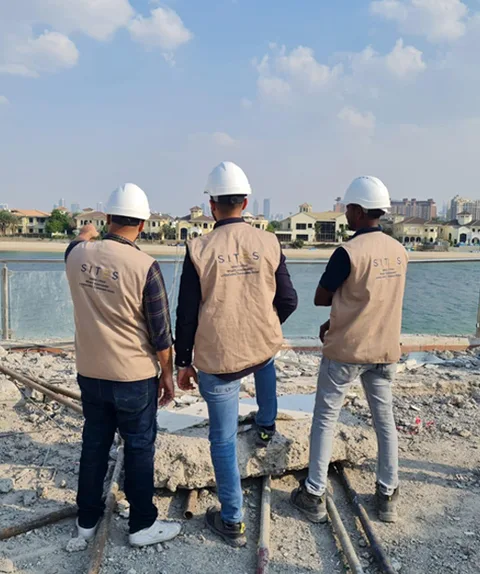
On The Beach House, E51 on Palm Jumeirah, around 80 percent of the villa was demolished to shell and core, with new MEP and HVAC throughout. That is a Trakhees permit, a Nakheel NOC, DEWA load changes and Civil Defence in one project, and it only works when someone owns the whole map. The same applies at a smaller scale: a Springs townhouse with a new pool still needs Emaar's NOC and a DM permit for the pool structure, and a Frond E extension that took the BUA from 549 sqm to 742.9 sqm was as much an approvals project as a construction one.
The permit is never the slow part. The resubmission is. Get the pack right first time and the programme holds.
If you are planning a renovation in Dubai and want the approvals handled properly from day one, talk to SITES Design & Build. Call +971 56 684 1636 or email hello@sitesdxb.com for a consultation, and we will map your community's NOC and permit path before you commit to a contractor.
Frequently asked questions
Do I need a permit to renovate a villa in Dubai?
Yes for anything structural, MEP, layout, external or extension related, which needs a Dubai Municipality, Trakhees or DDA building permit. Purely cosmetic work such as paint, flooring and fixtures usually needs no permit but almost always needs a community NOC from the master developer.
How long do renovation approvals take in Dubai?
Allow 3-7 weeks end to end: 5-15 working days for the developer NOC, then 10-15 working days for Dubai Municipality, 7-14 for DDA or 10-20 for Trakhees. A resubmission adds 2-3 weeks, so a complete first submission is the biggest time saver.
Who issues the permit for a Palm Jumeirah villa renovation?
Trakhees issues the building permit for Palm Jumeirah and other Nakheel areas, with Nakheel issuing the community NOC first. DEWA and Dubai Civil Defence approvals run alongside where services or fire systems change.